Review // Beirut’s Alternative Musical Scene // Part 2

[“A glance at Beirut’s contemporary alternative musical scene” was written for & published by ELLE ORIENT MAGAZINE in 2008]

To this day, I am not entirely sure what the initial spark was. I keep going through different scenarios and different events in my head, but I’m still unsure as to what started it all. It could have been Yasmine Hamdan’s tremulous voice, when the Soapkills took their first steps on a makeshift stage in a restaurant named Babylone, on the upper confines of Monot Street.  Or the vision of Jawad Nawfal and Victor Bresse laying complex rhythms on their electronic machines in Beirut’s Dome; or, closer still in time, the edgy voice of Charbel Haber as he professed eternal love and unavoidable damnation behind the wall of noise emitted by the Scrambled Eggs band…

Whichever the case, the actual beginnings of the Lebanese alternative musical scene escape me today. But this scene is so fertile, so diversified, so gloriously messy yet ultimately enchanting, that the details of its inception are irrelevant today. Much more important are its many actors, their numerous projects, and plans for a gloriously baffling future.

Yasmine Hamdan, the by-now legendary velvety voice of Soapkills, left Lebanon and her partner Zeid Hamdan’s barrage of rhythms, and exiled herself in France to work with famed electronic Mirwais (a mainstay of the French New Wave scene of the 80’s with his band Taxi Girl). The results of his collaboration with Yasmine Hamdan should be released imminently.

Zeid Hamdan, one of the most hyperactive musicians in Beirut’s alternative scene, has fronted a myriad bands in the last few years, excelling in various genres: punk/pop with the New Government (two releases on Lebanese independent label Incognito), Control/Shift Z (a dance project with Arab inflections), 3Arab (a fine blend of rock and dub), and countless others. Zeid is also hard at work scouting for new talent, and his efforts in that field have paved the way for the release of products from local Rap acts, including Katibe 5, Kita3youn, Kitaa Beirut, etc. Among these, the Katibe 5 crew stands ahead of the competition, and its debut album (also released by Incognito) is an infectious mixture of Arab rapping and hard-edged beats.

Jawad Nawfal and his Art.Core ensemble were among the first Lebanese artists to organize large-scale events gathering deejaying, live music, interactive video projections and photography. Some of these elements are still found in Jawad’s work today, as he fronts Electronica project Munma, a band that incorporates Middle and Far Eastern influences with its resolutely Westernized Electronic Ambient schemes. Munma’s first two EP’s were released on Incognito Records.  Jawad’s musical cohort of choice is ex-drummer Nabil Saliba, who performs on stage with Munma as synth-driven Trash Inc.

Electronic dance music’s Lebanese ambassadors of choice would be Lumi, a duo consisting of Marc Codsi (machines) and Mayaline Hage (vocals), whose jumpy electro-rock has earned them a successful commercial release with multinational label EMI records. 2008 saw them hard at work touring their debut album “Two Tears in Water”.

Whether bouncing on and off stage with local rock heroes Scrambled Eggs, improvising with experimental outfit XEFM, or interpreting his plaintive compositions alone on stage, Charbel Haber is an iconic figure in the contemporary Lebanese music scene, and feels perfectly at ease operating in this wide range of musical settings. Scrambled Eggs have released a handful of albums and EP’s, of consistently superior musical quality. 2008 also saw the release of a solo album by Haber, as well as collaborations with XEFM and U.S.-based bass player Miles Jay.

Among recent newcomers, let me point out The Incompetents, 4 young men hard at work creating an unreasonable mixture of Syd Barrett and Beach Boys influences, and more modern British pop trends. During their rare live appearances, they succeed in creating an extravagantly joyous shambles, while the release of their debut album will undoubtedly figure as a highlight of the year 2009.

Although less prominently ‘alternative’, the musical endeavors of singers such as Rima Khcheich and Tania Saleh hold a special place in the Lebanese contemporary panorama, as they mine a rich vein of Oriental Jazz and pop sensibilities.

The ongoing adventures of Beirut’s alternative music scene would not be possible without the staunch support of a stubborn group of individuals, active so-to-speak behind the scenes: promoters and festival organizers (Libanjazz’s Karim Ghattas, The Basement’s Jad Souaid, Byblos Festival’s Naji Baz…), producers (Incognito’s Tony Sfeir, Forward Productions’ Ghazi Abdelbaki), radio hosts (hailing mostly from the government-supported Radio Lebanon), whose efforts and relentless risk-taking surely play a vital part in ensuring the survival of this ebullient, diversified scene.

A full report on those bands that consistently set ablaze this writer’s enthusiasm would necessitate an obscenely large number of words and pages. At best, one can barely scratch the surface of this musical compendium, which regenerates itself constantly, and holds endless surprises for the patient and avid listener.

Ziad Nawfal


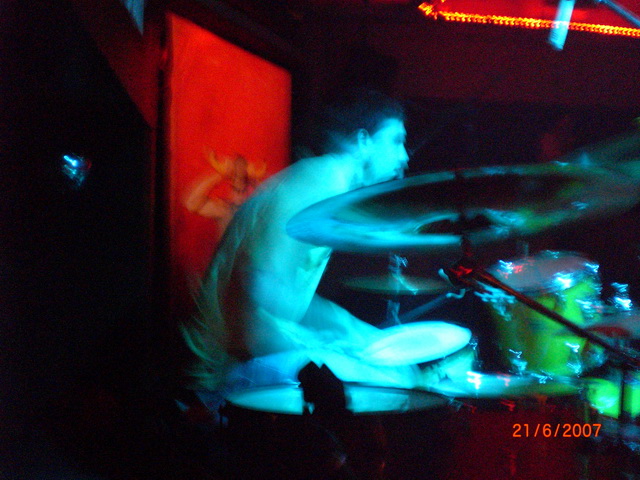
[Photo of Malek Rizkallah, drummer with Scrambled Eggs, by Ziad Nawfal]
pict0076


Review // Munma // Black Tuesday

[By Ziad Nawfal, December 2007]

Following an intense year performing live in Lebanon and abroad, Munma return to the studio in 2007 to deliver the 2nd volume of what is rumored to be a trilogy, hovering around the Lebanese-Israeli war of July 2006. The band’s familiar layers of synthesized sounds are augmented with a formidable array of processed bleeps and glitches, excerpts from radio speeches and political discourses, as well as expertly diverted samples of traditional Arabic instruments. The only live electronics band of its kind in Lebanon has managed to deliver yet another haunting masterpiece, a record that seems to defy any possible categorization and labeling, posed somewhere between ambient soundscapes, moody electronica, and weary world music.


LISTEN:

Audio 1: Pluie D’ete

Audio 2: IRM


JADE // Bande à Part Session #2 // 23 November 2007

Don’t Border me est né officiellement le 9 juin 2007,  à Montréal, grace aux efforts des journalistes Christelle Franca et Serge Abiaad. Le projet s’intéresse aux musiques et la création faite où les frontières géopolitiques sont trop rigides; là où la circulation des individus, des idées et d’une information honnête est aussi complexe qu’essentielle. Pour ses premiers pas, Don’t Border me a souhaité donner la parole à la musique libanaise actuelle.

Pour clôturer en beauté la première édition du projet Don’t Border me/Bande à Part, Jade (DJ résident et propriétaire du club The Basement à Beyrouth) livre un «DJ set» impressionant de maîtrise, et majoritairement dédié à la scène électronique locale.


Track listing:
1. SHANT: Kids
2. ROMAX: Not Meant To Be
3. AISHA: Get Togetha
4. FADY FERRAYE: Hashtray
5. MUNMA: City Traffic
6. ROMAX: Rosha
7. SHANT: Wandering
8. AISHA: Twist
9. MUNMA: Polymorph 2 + 3
10. SOAPKILLS: Tango


JAWAD NAWFAL // Bande à Part Session // 19 Nov 2007

Don’t Border me est né officiellement le 9 juin 2007,  à Montréal, grace aux efforts des journalistes Christelle Franca et Serge Abiaad. Le projet s’intéresse aux musiques et la création faite où les frontières géopolitiques sont trop rigides; là où la circulation des individus, des idées et d’une information honnête est aussi complexe qu’essentielle. Pour ses premiers pas, Don’t Border me a souhaité donner la parole à la musique libanaise actuelle.

Cinéaste du son et maître des machines, Jawad Nawfal a fondé Altered Ear, un laboratoire de recherche et de composition sonore assistés par ordinateur aux ramifications multiples : Ae_quo (expérimental), AEX (electro live), et Munma (oriental soundscape). Au croisement des disciplines multimédia, il collabore aussi régulièrement avec des réalisateurs et des artistes visuels, avec le Liban en bruit de fond.

Dans le cadre du projet Bande à Part/Don’t Border me, Jawad a soumis un soundscape (ou paysage sonore, un format qu’il affectionne particulièrement),  deux photographies, et a présenté sur Ruptures 96.2FM une émission ayant pour sujet la scène électronique libanaise.

Ecouter:
soundscape-jawad
bande-a-part-jawad-nawfal-19-nov07-part-1
bande-a-part-jawad-nawfal-19-nov07-part-2


sous-le-pont


cover-34days


La ville en chantier

Beyrouth est une ville étrange.
Les chantiers y sont incessants.
Je découvre sans arrêt de nouveaux bâtiments
surgis du néant là où, quelques jours auparavant,
il n’y avait qu’un vieux dépôt désaffecté,
un terrain de foot, une bâtisse croulante.
Les rues muent et se transforment au fil des
semaines, sans que personne ne semblent
vraiment s’en étonner.
En Juillet 2006, le pays a été l’objet
d’une vaste offensive militaire Israélienne.
Des quartiers entiers et de nombreux boulevards
de la capitale ont été détruits.
Ceci a évidemment eu pour conséquence la
recrudescence des chantiers en ville.
Aujourd’hui, Beyrouth est grise de poussière,
elle respire le béton et le métal rouillé.
Et même si le pays vit un cauchemars politique et
économique récemment, le chantier urbain est
intransigeant. Le métal et le béton règnent,
incontesté, déterminés, et rien ne semble pouvoir
les ralentir dans leur lourde progression.
Je les entends souffler, gronder et grincer.
Les sons que j’ai traités et mis en scène,
ces masses sonores fluctuantes, sont à l’origine
des bruits capturés sur des chantiers et ailleurs,
pas loin de là où j’habite. Je les ai pesés,
décousus, et taillés. Je les ai modulés
et transformés, tel un nouvel alliage secret.
Je leur ai donné une nouvelle voix.
Ainsi, vous aussi, vous pourrez peut-être y entendre
les lamentations fourbes de la ville en fusion.

Jawad Nawfal

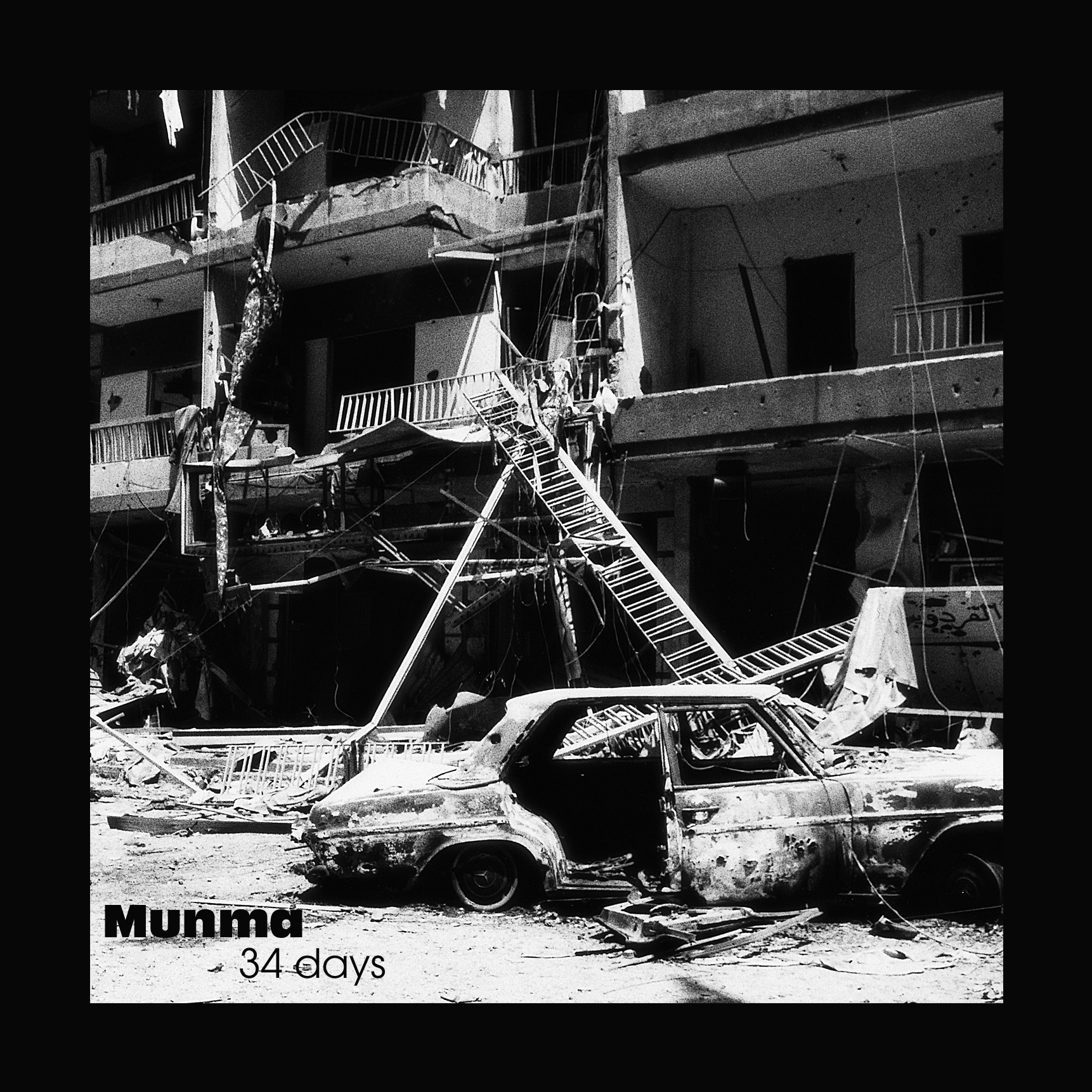
Review // Munma // 34 Days

[December 2006]

Although this is his first CD release on the Lebanese market, Jawad Nawfal has been active on the local dance scene for a solid number of years, under a variety of guises (AEX, Ae_quo, etc.). ’34 Days’ is a set of 6 electro-ambient tracks, featuring minimal beats, ominous vocal samples, and a rich tapestry of interlocking, layered sounds.

The album was recorded during Israel’s attacks on Lebanon in the summer of 2006, which explains to some extent the overall sombre and introspective mood of the tracks. At times, ’34 Days’ recalls the ethereal, hushed moods of Warp label artists such as Boards of Canada and Aphex Twin at his ambient best; with an oriental twist, added for good measure.


LISTEN:

Audio 1: Yaqiin

Audio 2: Qana